

By the Jynx Productions Team · 6 min read
I write here when something is worth thinking through. New pieces from Focus and the Jynx Journal go directly to subscribers.
There's a particular challenge that sits at the heart of everything we make for our German broadcast partners, and it's one that rarely gets talked about in production circles: how do you take a story that is viscerally, unmistakably American, soaked in American history, American politics, American geography, and make it land for an audience in Frankfurt or Munich, probably with dinner in front of them, trying to make sense of a country that sometimes feels like it's from another planet?
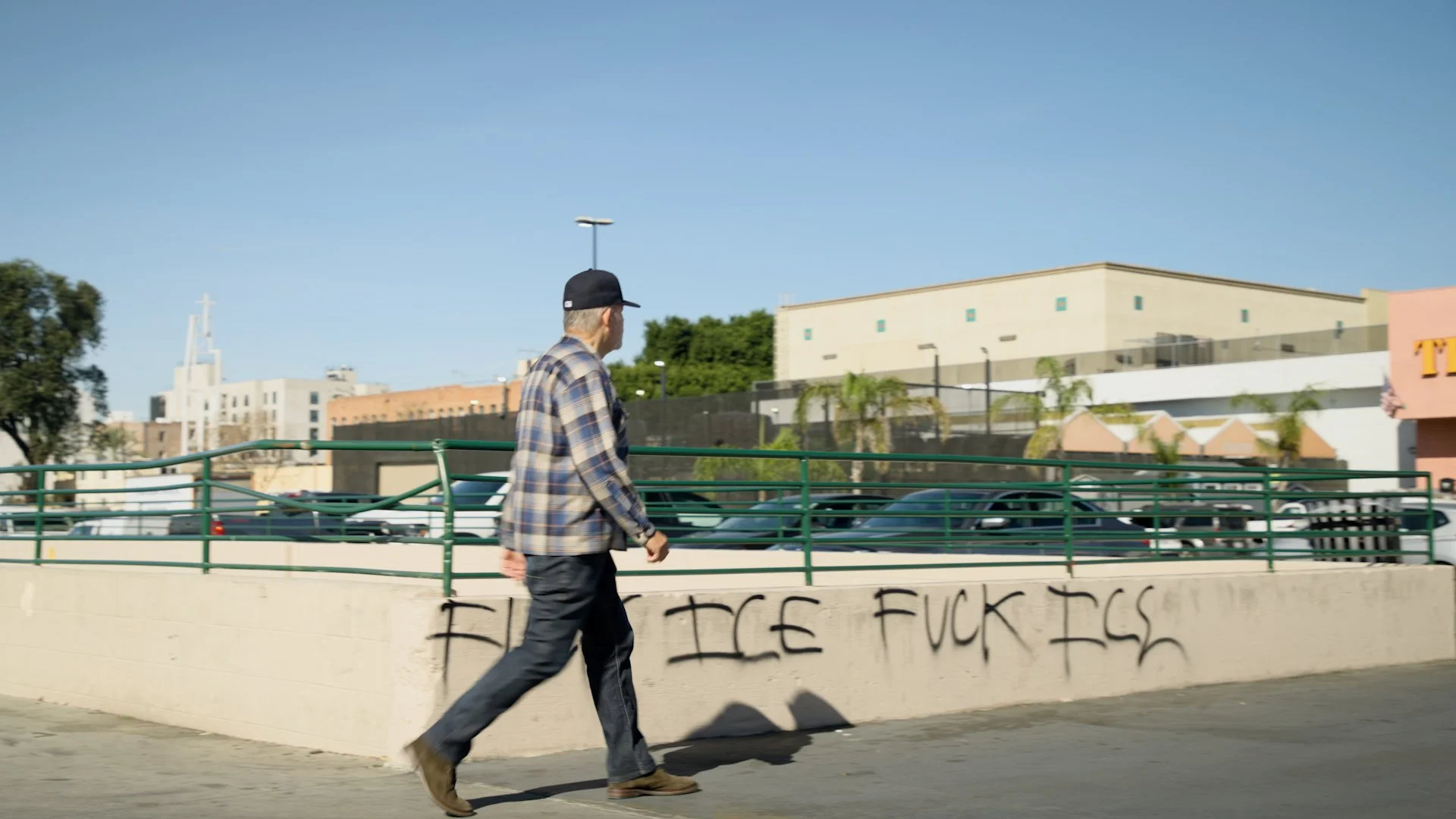
That's the real work. Not just filming. Translating. Our latest documentary for Galileo on ProSieben tested that skill as much as anything we've made in twenty years of production.
By the time we started development on this piece, the US Immigration and Customs Enforcement agency had become one of the defining images of American political life for European audiences. The footage was everywhere: masked, heavily armed officers conducting raids in residential neighborhoods, frightened families, protests spreading across American cities.
For a German viewer, the images were striking but the context was murky. What exactly is ICE? How does it work? Why are so many Americans (including Americans who once worked for the agency) speaking out against it? And crucially: is this new, or has America always been this way?
Those are the questions our Galileo editors needed answered. Not in a way that took sides, but in a way that illuminated. That's the editorial brief we work from every time.
The six-question format Galileo uses for this kind of explainer piece is deceptively demanding. Ten minutes. One subject. Six questions that have to carry the entire weight of a complex, politically charged story and leave a German audience genuinely better informed than when they sat down.
Finding the right subject was everything.
We didn't want a politician. We didn't want a protest organizer or a policy expert. We wanted someone who had been inside the machine, who could speak to what ICE actually is, how it actually works, and how it has changed, without an obvious axe to grind.
Ruben Martinez turned out to be one of the most compelling subjects we've ever put in front of a camera.
A Latino man who grew up in East Los Angeles, the son of a Mexican immigrant mother, who spent twenty years working for US immigration authorities, five of them as a deportation officer for ICE, and who now works for an immigration law firm helping people get out of the detention facilities he once helped fill. He has lived every side of this story. He carries the contradictions of it personally.

For a German audience trying to understand America, Ruben is something invaluable: a guide who doesn't fit the template. He defies the easy categories that international coverage of American politics tends to default to. He's not a villain, not a hero, not a simple symbol of anything. He's a human being with a complicated relationship to a complicated institution, and he speaks about it with the kind of honesty that only comes from someone who has genuinely wrestled with what they've done and who they are.
That kind of subject is what our journalistic approach is built to find and to draw out.
Here's where the real editorial work began - and where we think the craft of transatlantic documentary production is most often misunderstood.
Translation isn't just language. Our scripts go through German-language narration as a matter of course. That's the easy part. The harder work is cultural translation: identifying which parts of an American story a European audience will instinctively grasp, which parts need context they don't have, and which parts - if left unexplained - will cause them to misread the whole thing.
Take the geography of Los Angeles. For the story to work, a German viewer needed to feel the specific texture of East LA - what it means that this is where Ruben grew up, what it means that the ICE headquarters where he worked for years sits just a few streets from the restaurant where we filmed his conversation with community activists. The proximity is part of the story. But it's not self-evident if you've never been to Los Angeles.
Or take the history of ICE itself. The agency was founded in 2003, after September 11th, as part of the newly created Department of Homeland Security. Under Bush and Obama, its mandate focused primarily on serious criminals and trafficking networks. Under Trump, in both his first and second terms, the mission expanded dramatically: more raids, more arrests, a shift from targeted enforcement to maximum deportation as a deterrent. That arc matters enormously for understanding what Ruben is responding to. But it's not common knowledge in Germany, and without it, his testimony risks being read as simply anti-law enforcement rather than as a specific critique of a specific institutional transformation.
Writing that contextual narration, tight enough not to bog down a ten-minute film, clear enough to carry a viewer who genuinely doesn't know this history, is one of the less glamorous but most important things we do on every Galileo piece.
There was another layer of complexity on this production that we don't always encounter: we were filming while the story was still actively unfolding.

ICE operations in Los Angeles were ongoing during our shoot days. The communities we were filming in were living with the reality of raids happening, sometimes in the same neighborhoods we were working in that week. Ruben was actively working immigration cases. The community activists we filmed with were actively documenting ICE activity in their neighborhoods.
That's a different kind of production environment than a historical documentary or an institutional film. It required our team to be responsive in the field in ways that go beyond a standard shooting schedule - following where the story led on a given day, being sensitive to the level of trust our subjects were extending to us, and maintaining the editorial discipline not to sensationalize what we were seeing.
For our German editors, that ground-level texture was essential. It's one thing to report on ICE from a distance. It's another to show a viewer what it actually looks and feels like to walk through East Los Angeles with a former ICE officer, past the building where he used to work, through communities where people are genuinely afraid to leave their homes.
The film aired on January 26th, 2026, on Galileo. It's also available to watch on YouTube; we've added it to our “We Made This” playlist, where you can find our growing library of broadcast work.
We've been making films for German audiences for a long time now, and the question we get asked most often by prospective clients, particularly organizations outside the broadcast world, is some version of: Can you make our story work for an audience that doesn't already know us?
The honest answer is that this is precisely what documentary production at this level demands every single time. Whether the audience is German viewers trying to understand American immigration policy, or donors trying to understand the work of an NGO operating in a country they've never visited, or university alumni trying to connect with research happening in a field they left twenty years ago, the fundamental challenge is always the same. You have to earn the understanding of people who have no particular reason to care. You have to give them a way in. You have to find the human element that makes the unfamiliar feel urgent and real.
Ruben Martinez gave us that. A ten-minute film, six questions, one man with a complicated story about a country trying to figure out who it is.
That's what we do.
This segment aired on Galileo/ProSieben in early 2026, but you can watch it here on YouTube:
For 20 years of award winning production, Jynx Productions has specialized in presenting life as it unfolds to viewers across the globe. Our experienced production professionals are passionate about telling the kinds of authentic stories that leave a lasting impression on audiences. We’re glad to know that our work has sparked curiosity and joy, and has entertained millions of people.
Our clients cover a spectrum of industry sectors. We're always interested in building new relationships, showcasing our services, and we welcome opportunities to talk about collaborations.
Interested in how Jynx Productions would approach complex, cross-cultural storytelling for your organization or project? We'd love to hear from you!